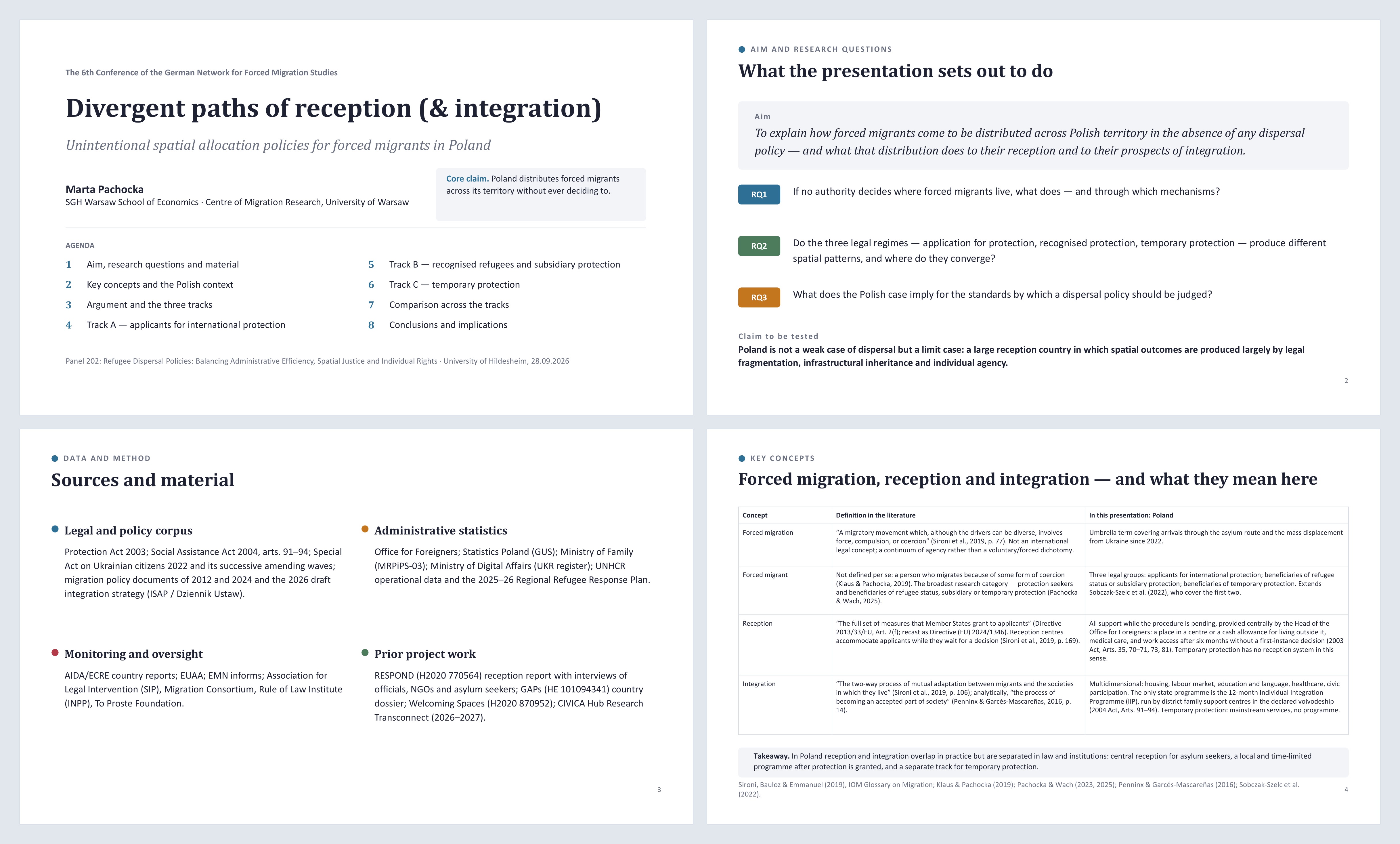
On 28 September 2026, Dr Marta Pachocka (SGH Warsaw School of Economics) took part in “Panel 202: Refugee Dispersal Policies: Balancing Administrative Efficiency, Spatial Justice and Individual Rights”, held as part of the 6th Conference of the German Network for Forced Migration Studies at the University of Hildesheim.
Conference website: https://www.uni-hildesheim.de/en/zbi/nwff2026/
The presentation
Dr Pachocka presented “Divergent paths of reception (& integration). Unintentional spatial allocation policies for forced migrants in Poland”. The aim was to explain how forced migrants come to be distributed across Polish territory in the absence of any dispersal policy, and what that distribution does to their reception and to their prospects of integration.
Research questions
- If no authority decides where forced migrants live, what does — and through which mechanisms?
- Do the three legal regimes — application for protection, recognised protection, temporary protection — produce different spatial patterns, and where do they converge?
- What does the Polish case imply for the standards by which a dispersal policy should be judged?
Three tracks of analysis
- Track A: applicants for international protection
- Track B: recognised refugees and subsidiary protection
- Track C: temporary protection, including forced migrants from Ukraine
The third track links the presentation directly to the initial focus of the CIVICA Research Hub TRANSCONNECT on post-2022 Ukrainian forced migration.
Claim to be tested
Poland is not a weak case of dispersal but a limit case: a large reception country in which spatial outcomes are produced largely by legal fragmentation, infrastructural inheritance and individual agency.
Research background and next steps
The presentation drew on Dr Pachocka’s research to date, including research conducted within the Hub, which she coordinates at SGH, as well as on her experience and research in other projects, including at the Centre of Migration Research UW. Part of the material was taken up during the Q&A, and the next step is to consider a publication.
Acknowledgements
Dr Pachocka would like to thank:
- the session organisers, Prof. Walter Bartl and Dr Philipp Lutz, for the invitation;
- the colleagues who presented their research in the panel, Dr Danielle Kasparick and Katharina Euler;
- Monika Szulecka and Ksenia Naranowicz for their consultations during the preparation of the talk.